An Independent Art Practice

About the Studio
Quiet Eastern Art for Modern Living
Golden Ink Arts is an independent art practice exploring the meeting point between traditional Eastern visual culture and contemporary life.
Rooted in Chinese calligraphy, Chinese painting, and the visual traditions of Thangka, the studio brings together the expressive movement of ink, the richness of colour, and the quiet presence of traditional forms.
Some works begin with a brush. Others take shape through digital processes. Across different materials and forms, Golden Ink Arts explores how Eastern artistic traditions can continue to speak to the world we live in today.
About Niohe
Golden Ink Arts: Where Tradition Meets Modern Stillness
A Journey Through Ink, Colour, and Tradition
My artistic journey began with the study of traditional Chinese painting and calligraphy.
I began practising calligraphy as a child. At the time, I did not understand why I had to use such a difficult brush to write. Calligraphy was simply something I was expected to learn. I had no idea what place it would eventually come to occupy in my life.
At eighteen, I was admitted to the Department of Chinese Painting at the Central Academy of Fine Arts, where I received formal training in traditional Chinese painting and calligraphy. As my studies progressed, I began to understand that painting and calligraphy were more than forms of expression. They also involved an understanding of line, colour, rhythm, and the relationships between forms and the spaces around them.
Murals and Thangka: An Important Encounter
During my university years, one of my teachers came from a family specialising in mural and Thangka painting. He taught us traditional Chinese mural techniques and shared his knowledge of colour, along with stories about the older generations of painters.
He once took us to visit Fahai Temple in Beijing. Its centuries-old murals were monumental in scale. Their surfaces were softened by a veil of dust accumulated over time, yet the paintings still held an extraordinary presence.
I was just a small figure within that vast space, straining to tilt my head back far enough to see the tops of the walls. I imagined the painters of centuries past, standing high on scaffolding, holding their breath as they carefully traced those long, flowing lines.
I found myself wondering how many people had worked on the murals, how long the work had taken, and how they had collaborated to create something so monumental. Who were those painters? What were their lives like? These questions carried my imagination far beyond the walls in front of me.
After leaving university, I continued studying Thangka with an inheritor of intangible cultural heritage in the field, as well as teachers associated with the Huarui Thangka tradition.
Thangka painting follows strict proportional systems. Even a small deviation in a line could be pointed out and corrected by a teacher. Using extremely fine brush tips, painters gradually fill large areas of colour, layer after layer, through patient and repeated work. This practice demands not only precision, but also an extraordinary degree of patience.
These different learning experiences gradually taught me that traditional art rests on both rigorous technical foundations and visual languages that can continue to be explored and reinterpreted.
Ink and Gold: Two Artistic Languages
Chinese calligraphy and Thangka have always spoken to me in different ways, yet I am equally drawn to both.
In calligraphy, the movement of the brush can create a sense of flow and rhythm. At the same time, every stroke and every character must respond to the others, finding its place through relationships of balance, spacing, and avoidance. I am continually fascinated by how a composition can feel both natural and expansive while also holding subtle, unexpected arrangements of space.
Thangka offers another kind of beauty. Its precise proportions, rich and intense colours, intricate lines, and luminous gold create a visual world that is both sumptuous and highly ordered. Even within elaborate compositions, every element has its place, and every detail contributes to the whole.
I love both of these artistic traditions, and I do not wish to give up exploring either of them.
Yet over time, I began to ask myself a question: must these art forms remain confined to sacred halls, seen from a distance and revered? Could they also find a place in people's everyday lives, rather than remaining apart from the world most people inhabit?
Golden Ink Arts: Bringing Tradition into Contemporary Life
These questions became the starting point for Golden Ink Arts.
Golden represents the rich colours of Thangka and traditional Eastern art, along with the radiance of gold. Ink represents the ink tones, brushwork, and open spaces found in Chinese calligraphy and painting.
Some of my works begin with a brush and paper. Others develop through digital media. I explore ways of bringing calligraphy, colour, traditional motifs, and elements of Eastern art into different forms, so that they can exist not only as paintings, but also as works to be encountered, used, and lived with in everyday spaces.
I do not want simply to repeat the forms created by earlier generations. Nor do I want to abandon these artistic traditions because they are old, or because they may seem distant from contemporary life.
I hope they can continue to find meaning in the world today, to be encountered, understood, welcomed, and appreciated by people in different places and cultures.
For me, this is an ongoing exploration: to understand the traditions that came before me while seeking forms of expression that belong to the present, allowing these time-honoured visual languages to continue their conversation with contemporary life.
FROM TRADITION TO CONTEMPORARY PRACTICE
My artistic practice grows from the study of Chinese calligraphy and painting, alongside my continued learning from Thangka traditions.
In the studio, brushwork, line, colour, and careful observation each play a part. Different materials and techniques offer different ways of seeing and making, shaping an artistic practice rooted in tradition while remaining open to contemporary expression.
Through this ongoing process, I continue to explore how traditional Eastern visual languages can find new forms in the world we live in today.
THE JOURNEY OF A THANGKA-INSPIRED ARTWORK
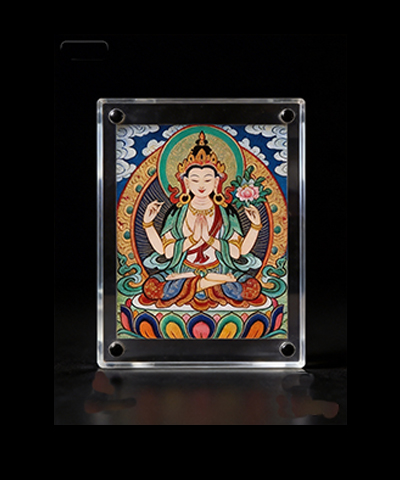
Some of my works begin with visual traditions associated with Thangka. Others grow from calligraphy, colour studies, or my own sketches.
As a work develops, I explore how lines, colours, and symbolic forms relate to one another within the composition — what to preserve, what to simplify, and how to shape these influences into a personal artistic expression.
The finished work is a contemporary interpretation informed by traditional Eastern visual culture. It is not simply a reproduction of a traditional Thangka, but part of an ongoing exploration of how these visual languages can speak to contemporary life.
Through painting, prints, and digital forms, I continue to explore different ways for these works to be encountered beyond the studio.