What Does the Buddha Eye Mean in My Artwork?

In my previous article, I talked about a question I am often asked:
Why do I paint only the Buddha Eye instead of the whole figure?
For me, the answer has something to do with looking.
When I simplify a complete Buddhist figure and leave only the eyes and a small number of symbolic elements, something interesting happens.
The image is no longer simply “a Buddha figure.”
It begins to become a space for thinking about looking, attention, and awareness.
This is why, for me, the Buddha Eye is not simply a detail taken from a religious image.
It has become one of the ways I understand meditation art.
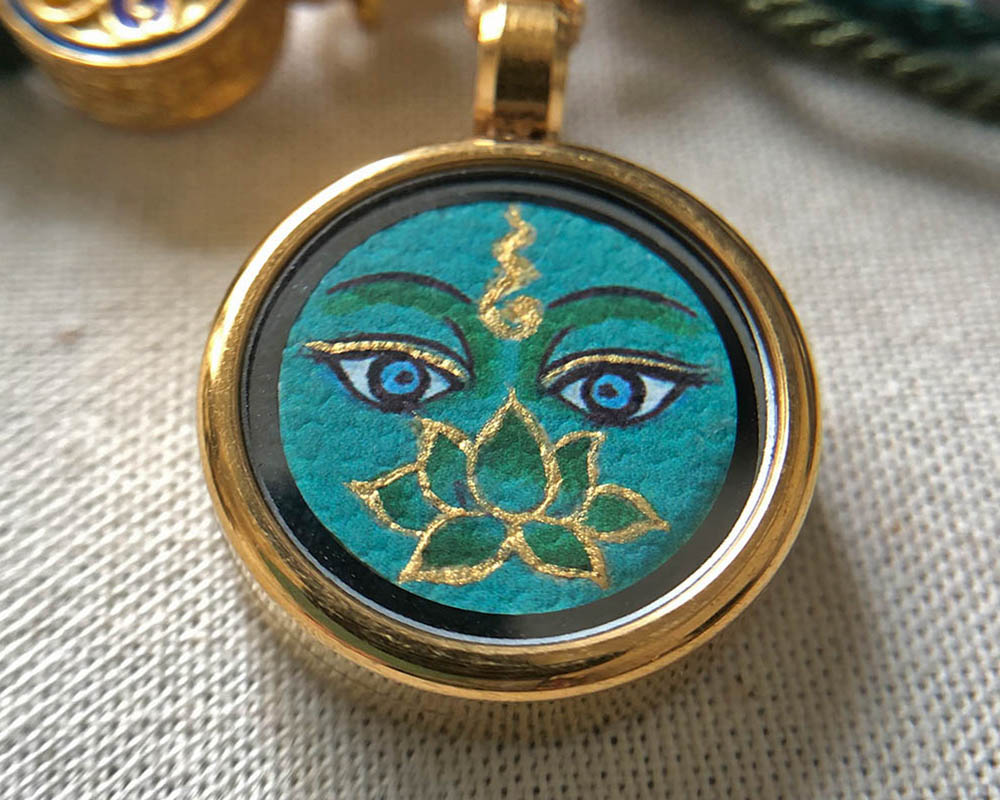
The Eyes Are Not Only for Seeing
We look at things all day.
Our phones.
Our computers.
The streets.
Other people's faces.
News.
Messages from work.
But seeing and being aware are not always the same thing.
Sometimes we see many things without truly noticing any of them.
Our eyes are working, while our minds have already moved on to the next thing.
This is one reason I am drawn to the eye.
It is simple.
But it can make us stop.
When you see a pair of eyes, you naturally form a relationship with them.
You begin to look at them.
And at the same time, you become aware that:
You are looking.
For me, that moment is already very close to meditation.
You do not necessarily have to sit down and close your eyes.
You do not necessarily need to follow a particular breathing method.
Sometimes, simply looking carefully for a few seconds is enough to bring your attention back from a busy state of mind.
Then Why the “Buddha Eye”?
My work does not begin with a completely abstract symbol.
It has a clear cultural origin.
I have spent many years studying Chinese traditional painting, calligraphy, and Thangka, and I have always been interested in the visual language of Buddhist art.
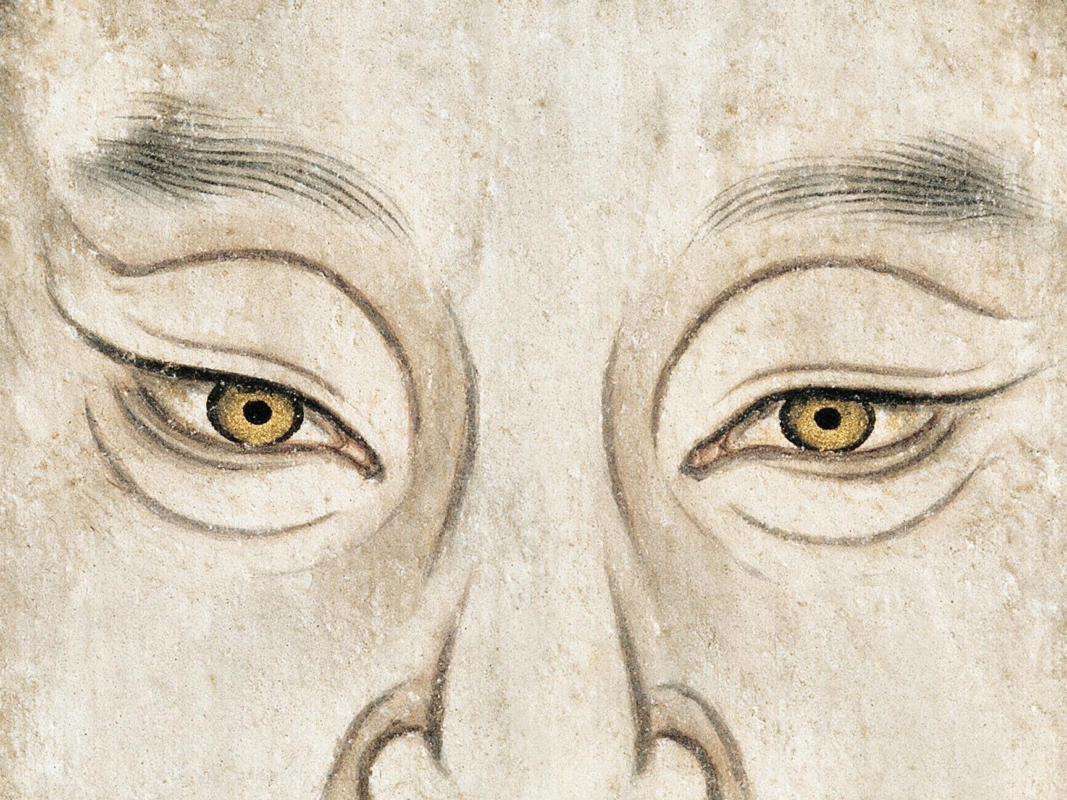
In traditional Buddhist art, the eyes are never simply decorative.
The gaze of a Buddha figure, the shape and position of the eyes, and the expression of the face all contribute to the character of the image.
Different Buddhas, Bodhisattvas, and protective deities also have their own visual and symbolic systems.
So when I simplify a Buddhist figure into the Buddha Eye, I am not trying to say:
“This is simply an ordinary pair of eyes.”
I want to retain something of its original cultural context.
At the same time, I am reducing a complex visual language into a visual focus that can enter contemporary life more easily.
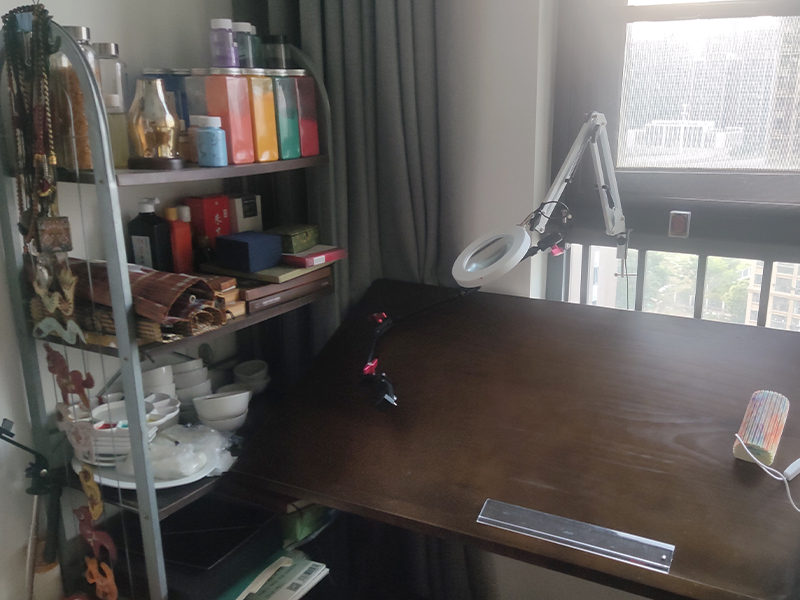
From Traditional Imagery to a Contemporary Artwork
Traditional Thangka contains an extraordinary amount of information.
The principal figure, attendants, ritual objects, gestures, ornaments, colors, background, directions, and symbolic elements all work together to create a complete visual system.
That completeness is an important part of traditional Thangka.
But when I began bringing this visual language into contemporary life, I started asking myself:
What happens if I keep only one part of it?
Can it still carry something of the original?
My answer is yes, but in a different way.
The Buddha Eye no longer asks the viewer to understand an entire religious composition at once.
It simply exists there.
You may know that it comes from Buddhist art.
Or you may not.
You may approach it through culture.
Or you may simply see it as a powerful visual artwork.
For me, this openness is important.
I am not trying to reproduce a complete traditional Thangka in miniature.
I am interested in what happens when a traditional visual language is reduced, moved into a different context, and seen in a new way.
Why Do I Like Making the Buddha Eye So Small?
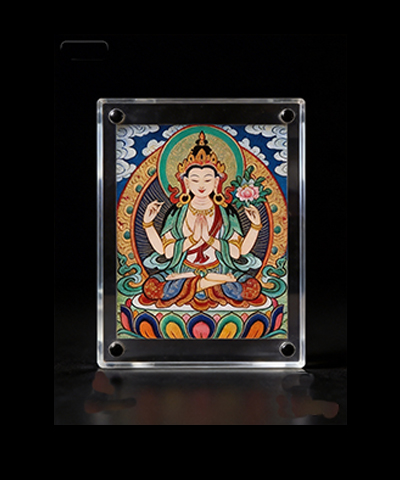
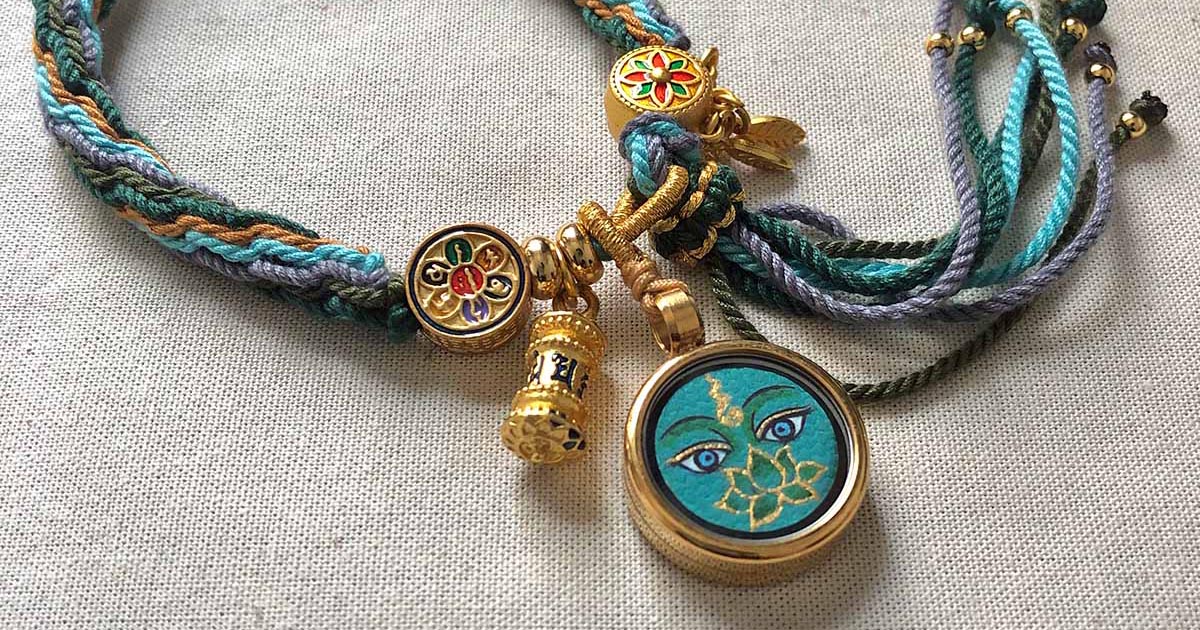
This is one of the reasons I began making small Buddha Eye works such as bracelets, portable acrylic pieces, and desk objects.
When a large Thangka hangs on a wall, it creates a certain distance between the artwork and the viewer.
You walk toward it.
You stand in front of it.
You spend time looking.
This is a very traditional way of encountering art.
But a small artwork creates a different kind of relationship.
It can sit on your desk.
On a bookshelf.
In your workspace.
It can even travel with you.
At that point, the artwork is no longer only something to look at.
It can also become a small visual presence that accompanies everyday life.
Why About 1.5 cm?
When I began creating the Buddha Eye as something that could be worn or carried, size became important.
Too large, and it begins to feel like a small decorative painting.
Too small, and the eyes and details become difficult to see.
A circular form of approximately 1.5 cm creates an interesting balance for me.
It is small enough to enter everyday life.
But when you look closely, you can still see the eyes, gold lines, and small details of the artwork.
From a distance, it is a small symbol.
Up close, it becomes a miniature artwork.
That change in scale is one of the things I enjoy about miniature painting.
Why Does It Work as a Bracelet or Portable Object?
Because the Buddha Eye has a very direct visual presence.
It does not need a large scale to exist as an image.
A circle.
A pair of eyes.
A few gold lines.
A small number of traditional symbolic elements.
Together, they can already form a visual language.
This is why I began experimenting with placing the Buddha Eye into objects that are closer to everyday life.
A bracelet.
A portable acrylic piece.
A small object for a desk.
They are different from a large Thangka.
They do not require you to dedicate an entire wall.
They can simply accompany you while you work.
While you read.
While you sit at your desk.
Or when you leave the room and take a small piece of the artwork with you.
Is It a Talisman?
This is something I think is important to explain clearly.
My work has a clear connection to Buddhist art.
Some of the Buddhas, Bodhisattvas, and protective deities represented in my work have their own symbolic and religious backgrounds within traditional Buddhist culture and practice.
But my contemporary artworks are not presented as objects that promise a particular supernatural power.
I would rather describe them as contemporary artworks rooted in traditional Buddhist visual culture.
If you practice Buddhism, the work may carry a deeper religious meaning for you.
If you are interested in Buddhist culture, it can become a small doorway into this artistic tradition.
And if you do not have a religious belief, it can simply be a small artwork that reminds you to pause, look, and breathe.
Different people can have different relationships with the same artwork.
I think that is perfectly natural.
What I Really Want to Leave Behind Is Awareness
So if you ask me:
“What does the Buddha Eye actually mean?”
I do not want to give you only one fixed answer.
It can be connected with traditional Buddhist culture.
It can be connected with looking.
With attention.
With stillness.
With the way we see ourselves and the world around us.
And in my artwork, what I hope it can become most of all is:
A reminder.
When you are rushing through your day and looking at a screen, you see it.
Pause.
When you have been working for a long time and your attention begins to scatter, you see it.
Pause.
When there are too many thoughts in your mind, you see it.
Pause.
You do not need to solve anything.
You do not need to force yourself to become calm.
Simply:
Look.
Breathe.
Return.
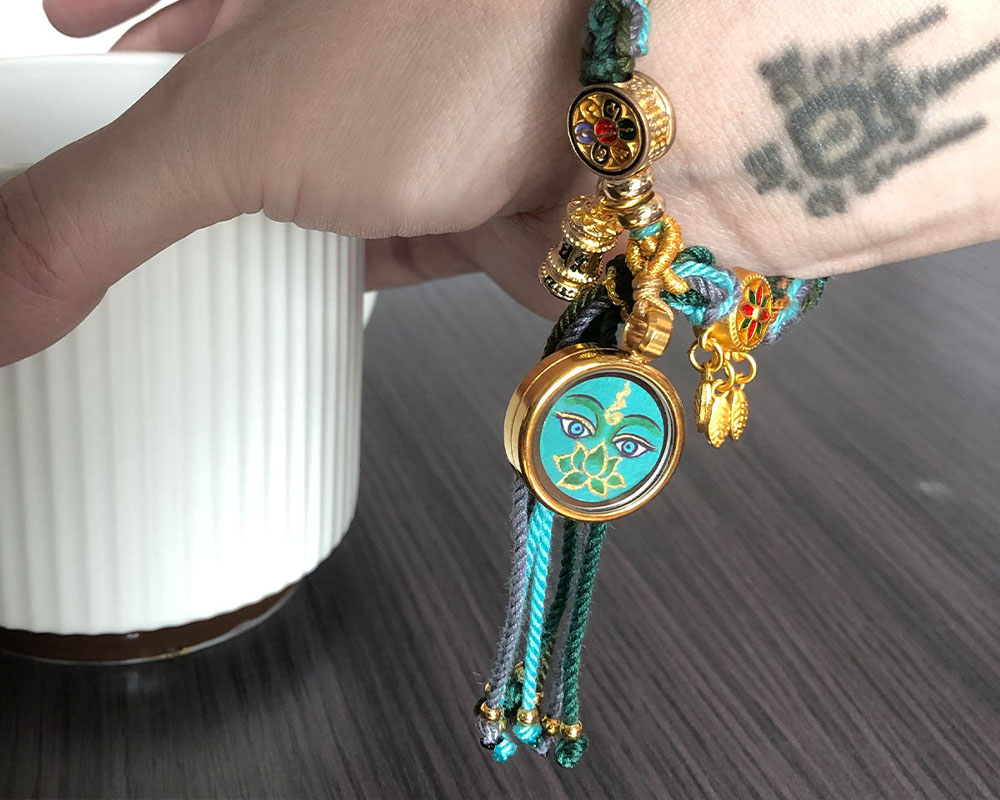
A Visual Symbol You Can Carry With You
This is why I have become increasingly interested in small Buddha Eye works.
Traditional art often requires a dedicated place for viewing.
But people today live in a very different environment.
Our lives are surrounded by screens, messages, work, and constantly changing information.
Perhaps an artwork does not always need to hang on a wall.
It can be small.
Small enough to sit on your desk.
Small enough to place inside a book.
Small enough to wear on your wrist.
Small enough to travel with you.
And still carry a visual memory rooted in an ancient culture.
This is the direction I want to explore.
Let traditional culture be more than something we collect.
Let it also be something we see.
Something we carry.
Something we bring into everyday life.
A Few Questions I Am Often Asked
Is the Buddha Eye artwork a religious talisman?
It is rooted in traditional Buddhist art and iconography, but my contemporary works are not presented as talismans or as objects with guaranteed supernatural powers. I create them as artworks that can be approached through culture, visual appreciation, or personal reflection.
Why do some Buddha Eye pieces use a 1.5 cm format?
I wanted the image to be small enough to wear or carry while still allowing the eyes, gold details, and painted texture to remain visible when you look closely.
Can I use a Buddha Eye artwork for meditation?
You can simply use it as a visual reminder to pause and pay attention. There is no required ritual or method. You can look at it, take a breath, and return to whatever you were doing.
In the End
I do not think the Buddha Eye has only one interpretation.
For me, it begins as an image rooted in traditional Buddhist art.
Then it becomes a pair of eyes.
And finally, it becomes a reminder.
A reminder that:
We are looking.
We are breathing.
We are still here.
Perhaps that is enough.
Traditional Roots.
Contemporary Gaze.
Quiet Energy.